

Cepheus: The King
| Object: | Cepheus |
| Location: | Narrowsburg, NY |
| Observer: | Roland Roberts |
| Time: | 10 Oct 2001 |
| Camera: | Pentax A3000, 50 mm f/2 lens |
| Film: | Kodak Elite Chrome II, ISO 200 |
| Exposure: | 11 minutes at f/4 |
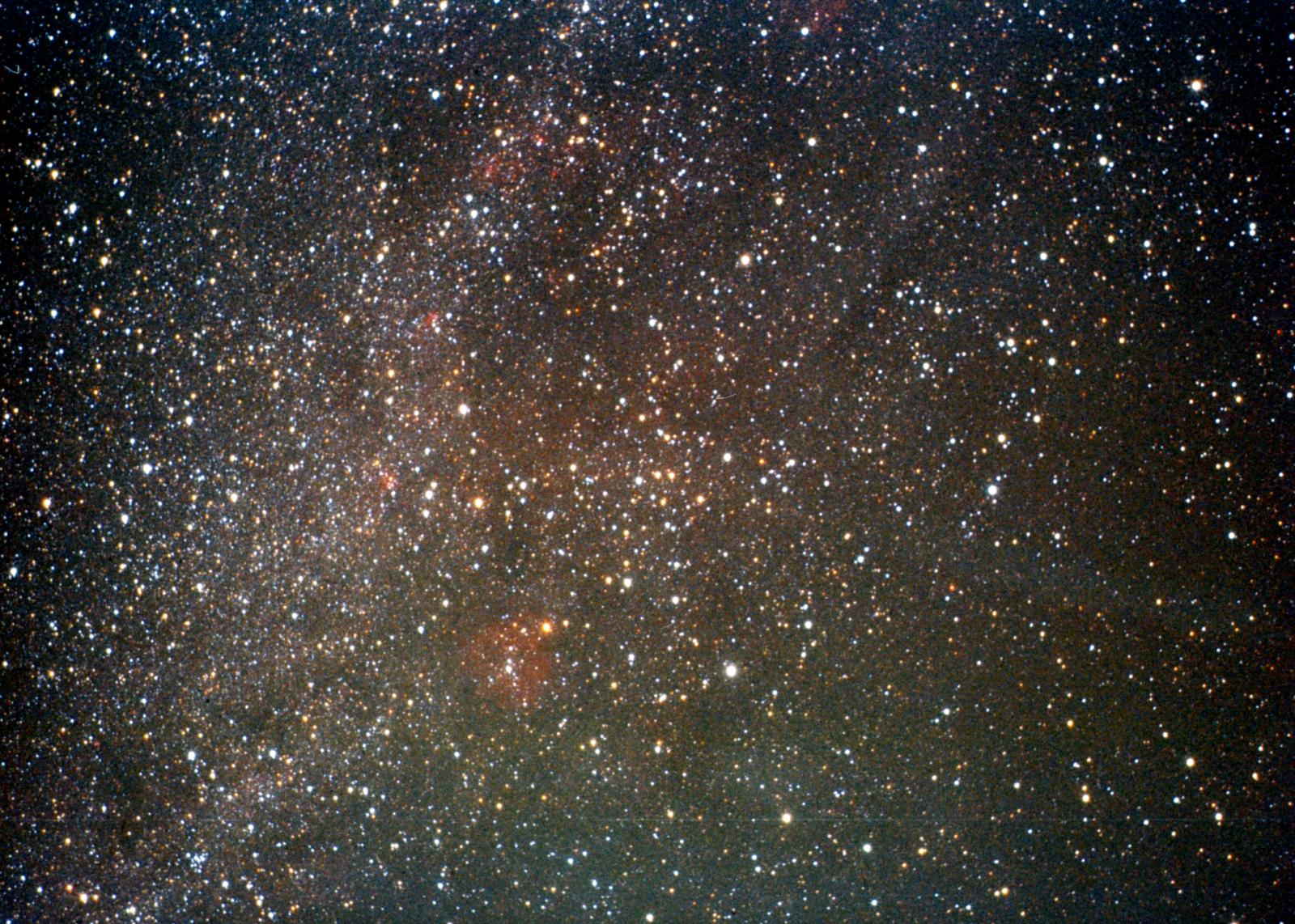
Not far from Cassiopeia lies Cepheus.
This was taken in mid-October of 2001 the same night I took a shot of Cassiopeia. This exposure was cut a little shorter than I had intended due to fog rolling in rather suddenly. Still, it came out reasonably well. Click on the image for a larger version.
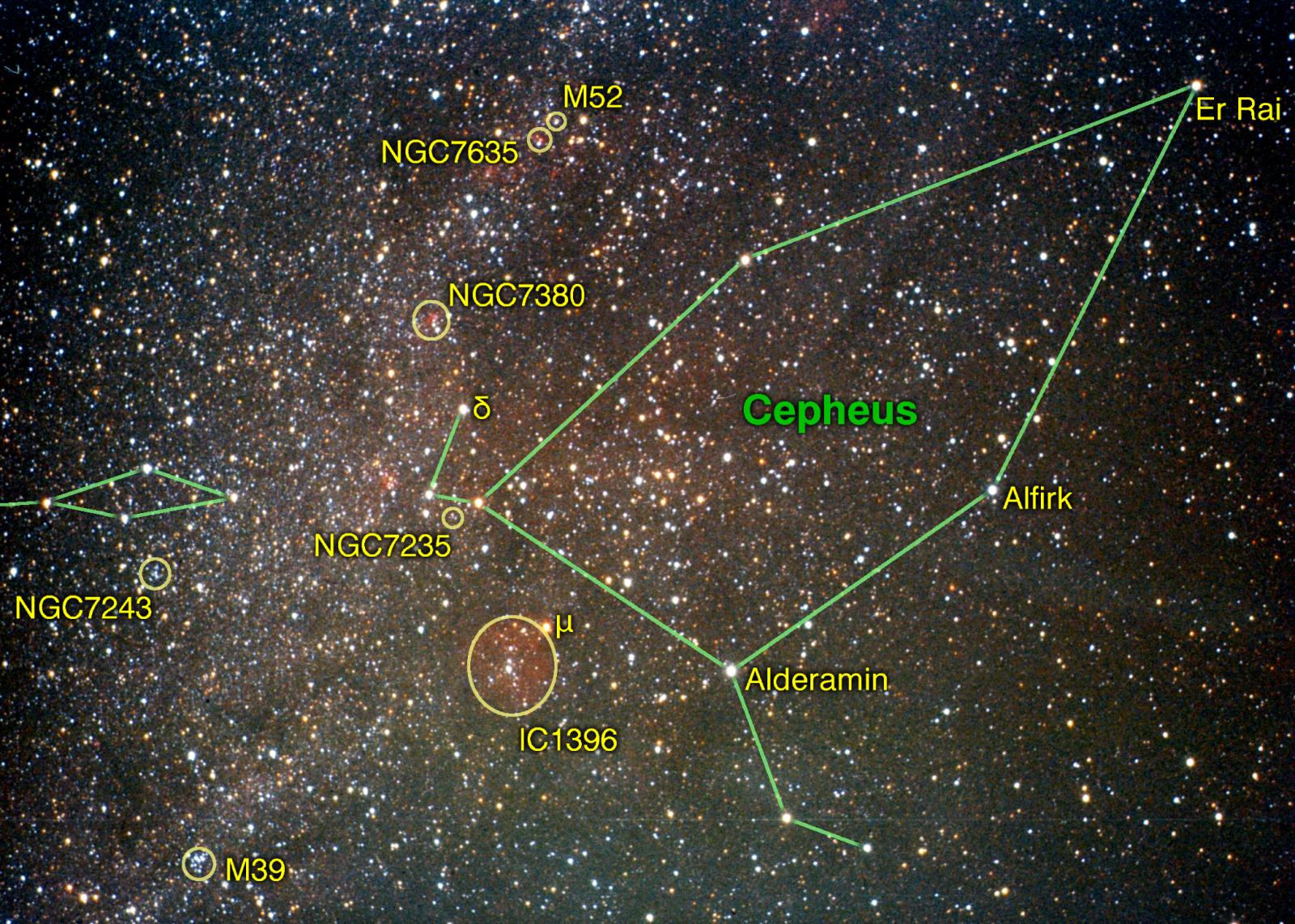
The constellation Cepheus is often described as a house shape (turn your head on its right side and squint). None of the stars in Cepheus are as extremely bright, and with it being so close to the Milky Way, it’s not hard to miss it when you first go looking (well, I had a hard time finding it). Peaking into the picture at the left is the head of Lacerta, the Lizard and the upper left corner of this picture actually belongs to Cassiopeia.
Labeled in both of these pictures are the following objects:
- Open Clusters (6): M52 (NGC 7654 which is really in Cassiopeia), NGC 7380, NGC 7243 (which is really in Lacerta), IC 1396, M39 (which is actually in Cygnus), and NGC 7235.
- Emission Nebulae (1): NGC 7635
- Stars (5): α (alpha) – Alderamin, β (beta) – Alfirk, γ (gamma) – Er Rai, δ (delta) and μ (mu) Cephei.
ξ (Xi) Cepheus, also known as Kurdah, is not shown on the overlay.
Delta Cephei has no name, but does have a reputation. This is the prototypical Cepheid variable whose regular brightness fluctuations were first discovered by John Goodricke in 1784 [1].
Mu Cephei has a not so well-known name of Erakis and is perhaps better known as William Herschel’s “Garnet Star.” It is among the most (if not the most) red stars visible to the naked eye from the northern hemisphere. It is nestled up against the edge of IC 1396 and is, in fact, partially obscured by it which also contributes to its redness.
Resources:
[1] Burnham, Robert Jr., Burnham’s Celestial Handbook, vol. 1, Dover Publications, 1978, p.583.