

Cassiopeia: The Queen
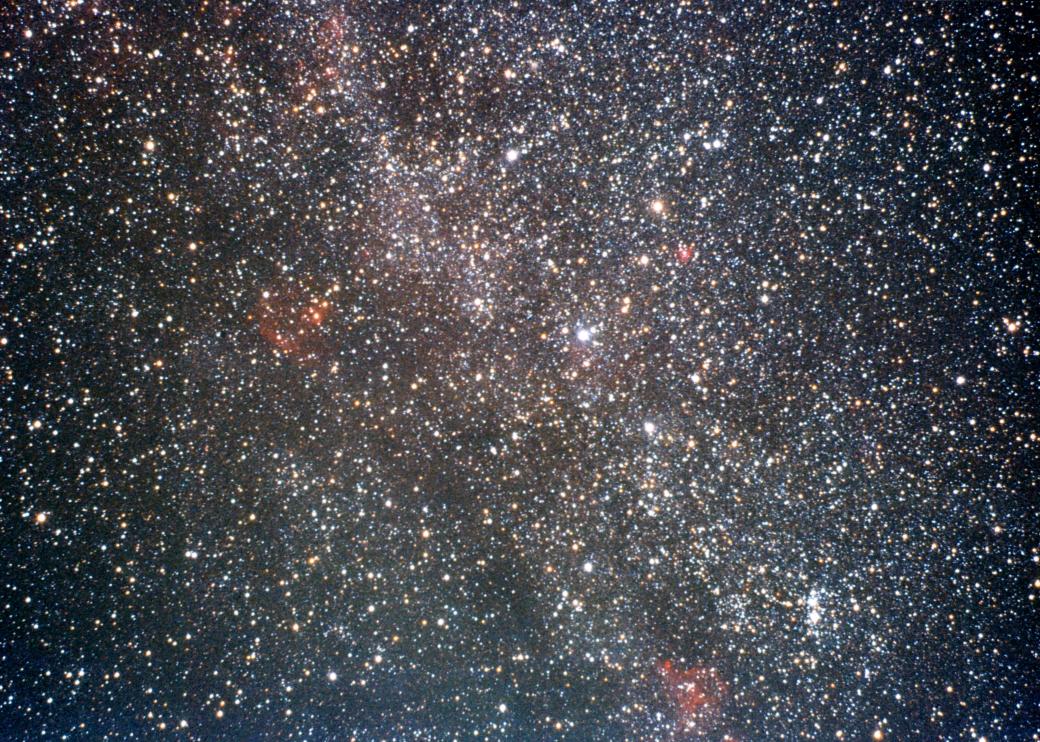
| Object: | Cassiopeia and the Northern Milky |
| Location: | Narrowsburg, NY |
| Observer: | Roland Roberts |
| Time: | 10 Oct 2001 |
| Camera: | Pentax A3000, 50 mm f/2 lens |
| Film: | Kodak Elite Chrome II, ISO 200 |
| Exposure: | 16 minutes at f/4 |
Cassiopeia lies high in the northern sky an is one of the few constellations which are visible year-round from the mid-northern latitudes where I live. Still, the fall and winter are the best times to view Cassiopeia since it lies further from the horizon that time of year. This was taken in mid-October of 2001 on a night when I had hoped to also get a second shot at Cygnus before it sank too low for this year.
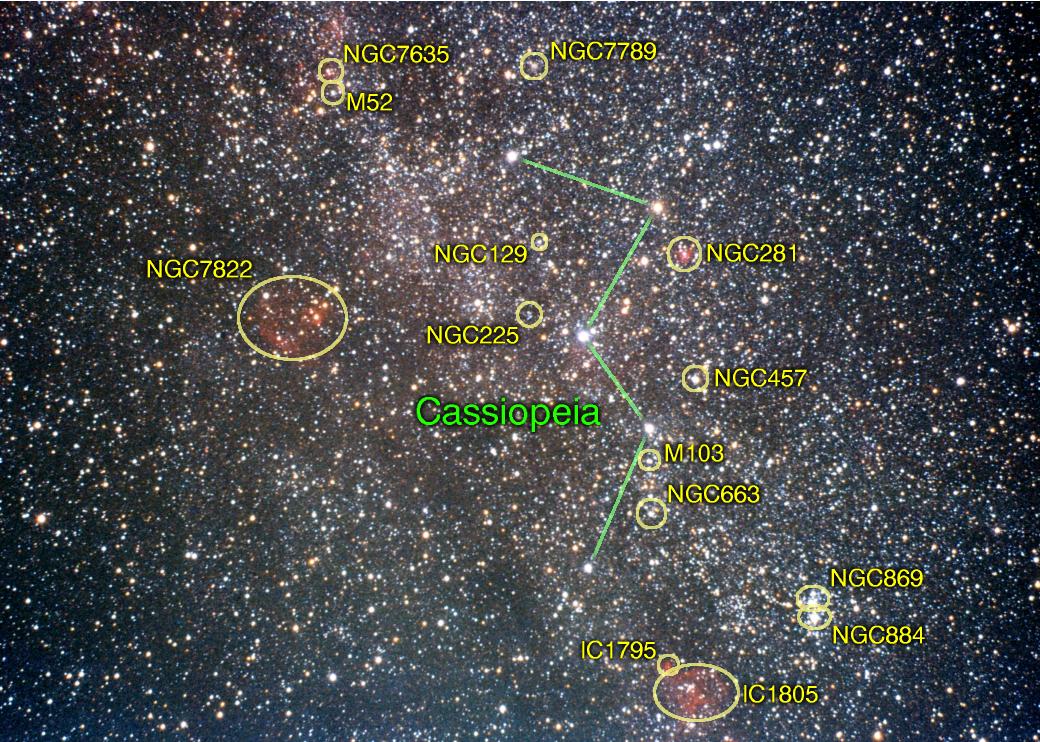
The constellation Cassiopeia is often described as a “W” shape (turn your head on its left side and squint). The “W” is not symmetric, but it generally works for finding it in the northern skies.
Labeled in both of these pictures are the following objects:
- Open Clusters (7): M52 (NGC 7654), NGC 225, NGC 457, NGC 663, NGC 869, which together with NGC 884, form the the well-known “Double Cluster” in Perseus, and NGC 7789, an open cluster
- Emission Nebulae (5): IC 1795, IC 1805, NGC 281 (the “Pacman Nebula”), NGC 7635 (the “Bubble Nebula”), and NGC 7822
- Stars (2): Schedir and Caph
Also visible in the image are the stars Achird, Cih, Rucha, and Segin.
The film response of Elite Chrome II seems a bit stronger in the red than the blue which lends an overall reddish hue to everything. Additionally, the color shift (according to Robert Reeve’s evaluation) is brownish for long exposure. To compensate for these effects, the color balance has been slightly shifted toward the blue in these images.
Resources: